

Experimental fields
The Prof. Marian Górski Experimental Station is a part of the Institute of Agriculture, Warsaw University of Life Sciences – SGGW, Poland. The Experimental Station is located in Skierniewice, central Poland. The Experimental Station includes fields in three locations: Skierniewice, Miedniewice and Chylice.
Skierniewice
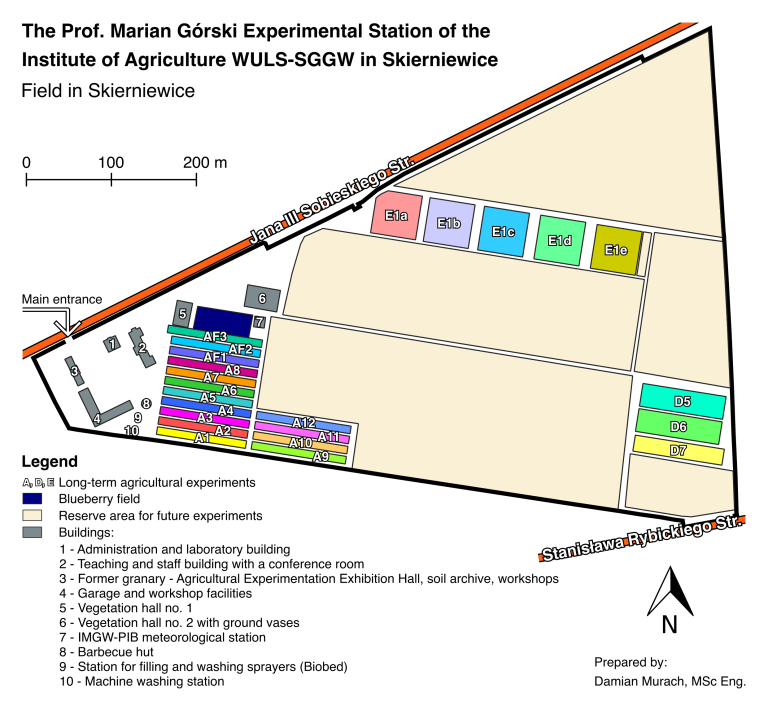
Skierniewice is the seat of the The Prof. Marian Górski Experimental Station. The infrastructure of the Experimental Station is as follows:
- long-term fertilization experiments,
- facility with a laboratory
- facility with a conference hall
- facility with a Historical Room of Agricultural Experimentation
- facility with experimental pots
- vegetation hall
- weather station established in 1921
- machinery park
The long-term fertilization experiments in Skierniewice were established in 1921 on Luvisols. These experiments are the oldest existing experiments in Poland, 5th in Europe and 7th in the world. The experiments have been carried out on an area of 4.8 ha where 670 plots are located.
The experiments have been carried out in various fertilization combinations (Ca, CaNPK, NPK, CaPK, CaPN, CaNK, PK, PN, KN, farmyard manure) including control plots with no fertilization.
The four crop rotation are applied: 1) 5-field crop rotation, 2) rotation without manure and legumes, 3) rotation without manure with legumes and 4) 3 monocultures (rye, potatoes and triticale).
Chylice
The Chylice is the oldest agricultural farm at the Warsaw University of Life Sciences, donated to the University in 1921 by Michał Sobański Fundation. The first experiments in Chylice were
organized in the 1920s by Prof. Józef Mikułowski-Pomorski. Since 1951, at the initiative of Prof. Mieczysław Birecki, experiments of crops cultivation methods and soil fertility improvement were
established. In the following decades, various units at Warsaw University of Life Sciencesconducted a lot of experiments related to plant varieties and cultuviation, fertilization and meadow
management. For many years, the Department of Agronomy has provided scientific andsubstantive supervision of the field experiments.
Three long-term field experiments are being conducted in Chylice: Z-3/55 and Z-4/55 (since 1955) with different fertilization (NPK, ½ NPK + ½ manure, manure, and no fertilization) in two crop rotations,
and U-6/75 (since 1975), comparing direct sowing, plough cultivation, and, since 2011, ploughless cultivation with a stubble cultivator. Its location on black soils means that Chylice complements the
research base of fields in Skierniewice and Miedniewice, located on brown and loamy soils.
Miedniewice
The experimental field in Miedniewice was established in 2010 for the scientific and teaching needs of the Department of Agronomy. The facility covers an area of 8.2 hectares and comprises
11 fields, each with an area of 0.6 hectares. These fields are used to grow crops in a three-field crop rotation system representing different farming systems: conventional intensive (winter
rapeseed → winter wheat → spring barley), conventional integrated (sugar beet → spring wheat→ narrow-leaved lupin → winter wheat) and organic. The field in Miedniewice also includes
permanent grassland (TUZ) maintained in a conventional system. Since 2011, a permanent experiment with tillage systems (traditional ploughing, ploughless stubble cultivation and strip-till)
has been conducted on a separate part of the fields in the conventional system (intensive and integrated). A certified organic field is an integral part of the experimental field in Miedniewice.
The basis for the research topics carried out on the organic field is 2.4 ha of arable land, onwhich, since 2013, crops have been grown in a four-field crop rotation: sugar beet → spring wheat
with red clover undersown → red clover → winter wheat (spelt), and 1.6 ha of permanent grassland.
The Prof. Marian Górski Experimental Station gives an opportunity to carry out studies on the influence of long-term diversified fertilization, crop rotation and tillage systems on soil physical and chemical properties, soil organic matter stability and crop yield.
We invite you to cooperate with us.
Institute of Agriculture
Warsaw University of Life Sciences – SGGW, Poland